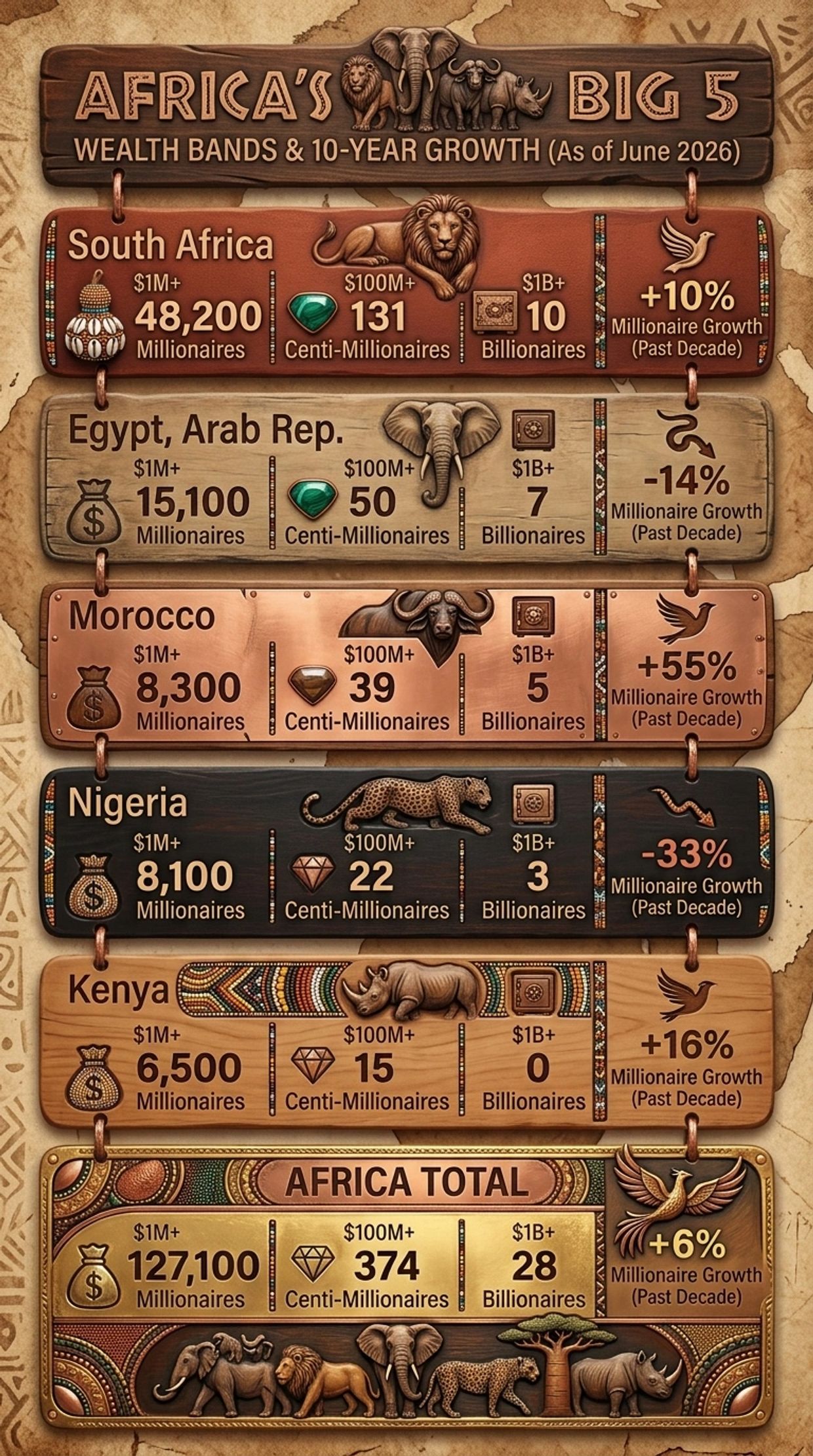
Note: All figures as at June 2026 (in USD terms). HNWI figures rounded to nearest 100.
Source: The Africa Wealth Report 2026

The rise of South Africa
Following a strong past two years, South Africa is now the wealthiest country in Africa by some margin with 48,200 HNWIs in residence as at June 2026, along with 131 centi-millionaires and 10 billionaires. This means SA now accounts for a substantial 38% of Africa’s total millionaires and 36% of its billionaires.
On a global view, South Africa ranks as the 34th wealthiest country on earth when it comes to millionaire residents – just behind Poland and ahead of major players like Turkey and Thailand.
SOUTH AFRICA'S MOST BANKABLE ARTISTS
Art collecting is one of the top hobbies for HNWIs in South Africa. The SA fine art market is valued at over USD 600 million as at June 2026 - this refers to the combined value of the artworks that are traded regularly at auction.
The Perfect 10:
Works by the following 10 artists are especially popular among top-end art collectors in South Africa:
- Gerard Sekoto
- JH Pierneef
- Irma Stern
- Maggie Laubser
- Alexis Preller
- Vladimir Tretchikoff
- William Kentridge
- John Meyer
- Sydney Kumalo (sculpture)
- Anton van Wouw (sculpture)
Irma Stern traditionally sets the top prices at art auctions in Africa. Her paintings can fetch up to USD 3.0 million each, with an average price of around USD 250,000 per painting.
This report features art by Maggie Laubser and Vladimir Tretchikoff.

AFRICA'S WEALTHIEST CITIES
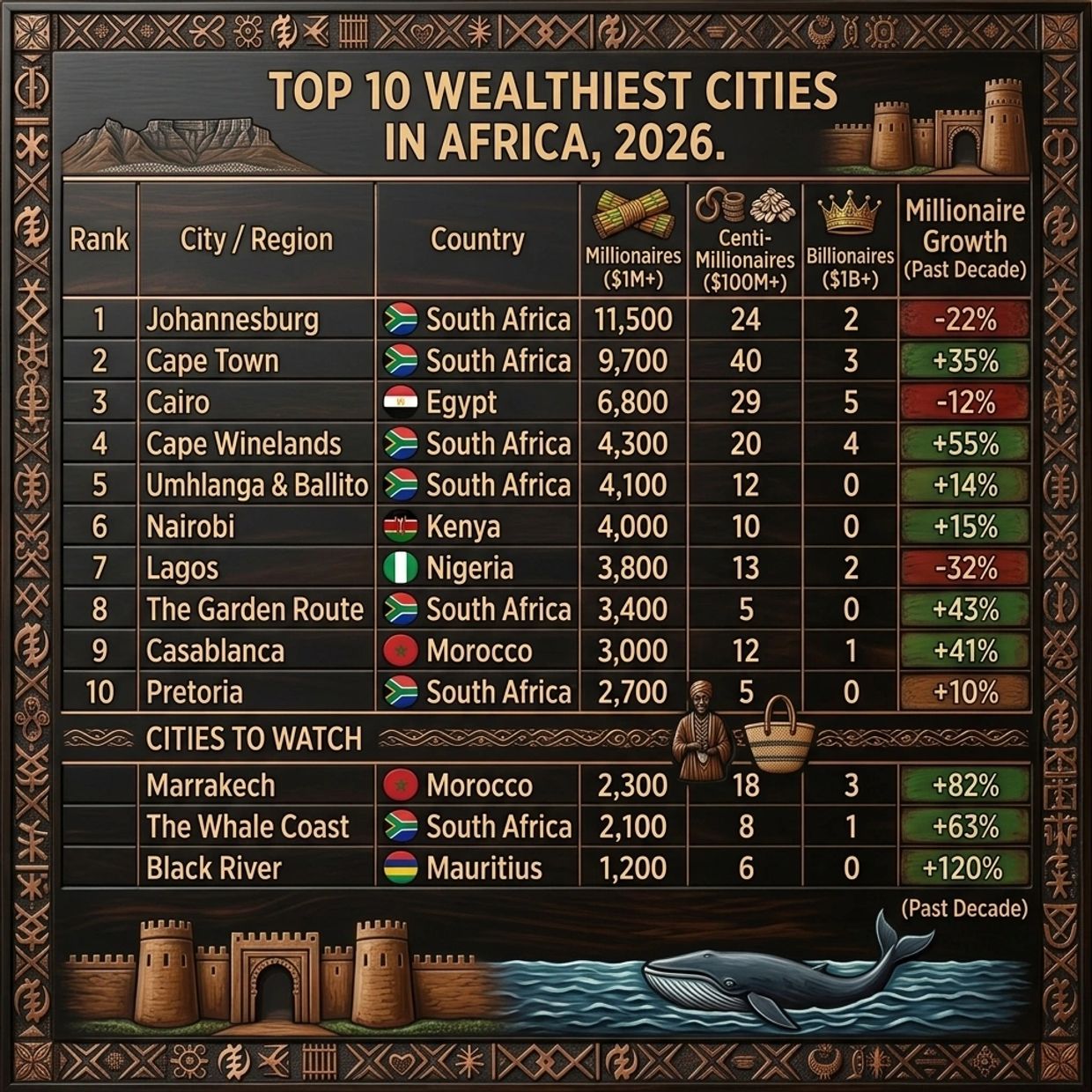
Note: All figures as at June 2026 (in USD terms). HNWI figures rounded to nearest 100.
Source: The Africa Wealth Report 2026
Africa's fastest growing millionaire hotspots

The Cape Winelands
This area includes the neighboring towns of Paarl, Franschhoek, and Stellenbosch. It is the 2nd largest billionaire hub in Africa (after Cairo) and an increasingly popular destination for wealthy retirees, with exclusive lifestyle estates such as Val de Vie, De Zalze, Winelands Estate and Domaine des Anges. It has experienced wealth growth of +55% over the past decade.
The Garden Route
Stretches from Mossel Bay to Storms River on South Africa’s South Coast. Notable towns on the route include Plettenberg Bay, George, Knysna, Wilderness, and Mossel Bay, as well as smaller up-and-coming wealth hotspots such as Natures Valley and Keurboomstrand. Beachy Head Drive in Plettenberg Bay is especially affluent and has a strong claim to being crowned “Africa’s Millionaire Row”. The Garden Route has seen wealth growth of +43% over the past decade.
Marrakech
Known for its beautiful architecture, Marrakech is an increasingly popular retirement destination for HNWIs from the Middle East and Europe. It is also Africa’s top luxury tourism hub with world famous hotels such as Royal Mansour and La Mamounia. The city has shown impressive wealth growth of +82% over the past decade.
The Whale Coast
The Whale Coast is the area between Cape Town and the Garden Route. It includes the wealth hotspots of Hermanus, Rooi Els, and Betty’s Bay, and is South Africa’s fastest growing region for high-net-worths with wealth growth of +63% recorded over the past decade. The Hermanus suburbs of Voelklip, Kwaaiwater, Eastcliff, and Fernkloof Estate are especially affluent.
Black River (Tamarin)
Black River in Mauritius is the fastest growing millionaire hotspot in Africa with wealth growth of +120% recorded over the past decade. It includes the affluent town of Tamarin, where prime property is highly sought after, especially among wealthy expats from South Africa.
Africa's top emerging musicians AND filmmakers
From AfrikaBurn to Cape Town Film Studios - the entertainment industry is emerging as one of the fastest growing sectors in Africa. As part of this year's Africa Wealth Report, we review the top up-and-coming musicians & filmmakers on the continent.
The creative force behind District 9 and Elysium, South African-born Blomkamp is fast becoming one of Hollywood's top science fiction filmmakers. He is widely recognized for his gritty, grounded approach, which heavily integrates social commentary, high-concept industrial aesthetics, and cutting-edge visual effects.
Like Bob Dylan and Joan Baez before her, Ruth is emerging as the voice of a generation. Her music is the perfect mix of folk, rock, and blues. She hails from South Africa, a nation that has produced many of the continent's top musicians, including Johnny Clegg, Sipho Mchunu, Miriam Makeba, Mandoza, and Hugh Masekela.
Tanzanian singer, songwriter, fashion entrepreneur, and one of East Africa's fastest growing contemporary R&B artists. Beyond his music, Jux has successfully carved out a parallel identity as a fashion icon and entrepreneur.

AFRICA'S TOP ECO-ESTATES FOR 2026

New World Wealth have been visiting and rating the world’s top estates for almost a decade. Eco-estate living is on the rise globally, especially among the wealthy. We estimate that by 2050 over 60% of Africa's centi-millionaire population will either live in, or own second homes on eco-estates.
For our purposes “eco-estates” refer to residential estates with natural indigenous wilderness areas, strong biodiversity and vast birdlife. We include both wildlife estates as well as traditional lifestyle estates under this umbrella. South Africa is the global pioneer in eco-estate living and is home to many of the world’s top examples.
Our top five estates for 2026 are listed below (in no particular order):
VIPINGO RIDGE
Kenya’s premier lifestyle destination is home to a wide array of birdlife including Palm-nut Vultures and Carmine Bee-eaters. The estate also features one of Africa’s most celebrated golf courses – the Baobab course at Vipingo Ridge.
LIKWETI
Likweti Bushveld Farm Estate is located near the small town of White River, just outside of Kruger National Park. The birdlife on the estate is fantastic and renowned bird guide Marc Cronje leads a regular bird walk there which is highly recommended. Notably, two of the World’s Big 10 Eagles have been spotted on the estate – the Martial Eagle and the Crowned Eagle.
FINKENSTEIN ESTATE
Located just east of Windhoek, this prestigious estate borders the Moltkeblick Game Farm, with freedom of movement between the game farm and the estate. The vegetation and topography there is very unique, which creates lovely views and sunsets.
WALKERSONS
Walkersons Private Estate is located in Dullstroom, South Africa’s highest town. It features a crystal clear stretch of the Lunsklip River with 20 weirs and several lakes, making it one of the world’s premier fly-fishing estates. It’s also a great spot for birdwatching, hiking and horse riding - with top-class stables on the estate.
ROYALSTON
Royalston Coastal Wildlife Estate is located just outside of Port Elizabeth. The estate has a nice mix of forest & grassland vegetation and is a sanctuary for many rare & endangered species, including Honey Badger, Caracal, Sable Antelope, Knysna Woodpecker and Crowned Eagle.
THE BENEFITS OF ECO-ESTATES
The environmental benefits of eco-estates are wide ranging:
• They favor indigenous plants and trees.
• They protect river systems that flow through the property.
• They advocate for “green tech” practices such as solar energy, plastic recycling and composting.
• They keep dead and dying trees. Many of the world’s rarest birds including woodpeckers and parrots depend on the cavities of dead trees to nest. This is because the wood is softer and therefore easier to dig holes into than live trees.
• They embrace organic forms of pest control. One example of this comes in the installation of owl boxes, which encourage owls to live on the estates. Owls serve as an organic form of pest control as they keep the rodent population down.
RATINGS CRITERIA
Our top five estates score strongly in the following areas:
• Location, views and scenery.
• Environmental condition of any rivers and lakes on the estate.
• Birdlife & biodiversity.
• “Green tech” practices such as solar energy, plastic recycling and composting.
• Environmental awareness – indigenous vegetation, owl boxes, keeping dead trees etc.
• Design, space and architecture.

FUTURE TRENDS IN AFRICA
Going forward, Africa’s wealth is projected to rise sharply, with millionaire numbers on the continent forecast to more than double by 2040.
In particular, we expect strong millionaire growth in “lifestyle destinations” such as Cape Town, Marrakech, the Whale Coast, the Garden Route, Tangier, the Cape Winelands, Nairobi, Windhoek and Swakopmund.
Our projections for Namibia are especially bullish, mainly due to its tax benefits. Notably, Namibia does not tax foreign income and imposes no capital gains tax or estate duty. The capital gains exemption places it in an exclusive group alongside the UAE, the Cayman Islands, Monaco and Singapore.
Namibia also has a very well-developed banking system and a comparatively high level of safety when compared to most other African countries. With over 40% of its land protected by national parks and conservancies, it is also one of the most ecologically friendly places on Earth, with a number of top eco-estates including Finkenstein Estate and La Muela - see more on the Rise of Namibia.
According to Andrew Amoils, head of research at New World Wealth: "Over the next decade, we expect the key wealth-creating industries in Africa to be eco-tourism & eco-estates, music & film, fintech, ecommerce, software development, AI, business process outsourcing, green tech, rare metals mining, biotech, and wealth management."

NOTES
- The terms ‘millionaires’ or ‘high-net-worth individuals’ (HNWIs) refer to individuals with liquid wealth of USD 1 million or more.
- The term ‘centi-millionaires’ refers to individuals with liquid wealth of USD 100 million or more, whilst ‘billionaires’ refer to individuals with liquid wealth of USD 1 bn or more.
- For our purposes ‘liquid wealth’ includes equities, ETFs, cash, bonds, gold, and crypto holdings - namely, items that can be cashed in quickly.
- We exclude illiquid items such as property, family businesses and private equity, which is why our wealth figures tend to be lower than the other vendors.
- All figures as at 30 June 2026 and all in USD terms.
- HNWI figures rounded to the nearest 100.
About New World Wealth
New World Wealth was established in 2013 and has been tracking the movements and spending habits of the world’s wealthiest people for over a decade.
Our reports and findings have been referenced by the Australian and UK governments, as well as by global news outlets such as Bloomberg, CNN, Forbes, CNBC and Robb Report.
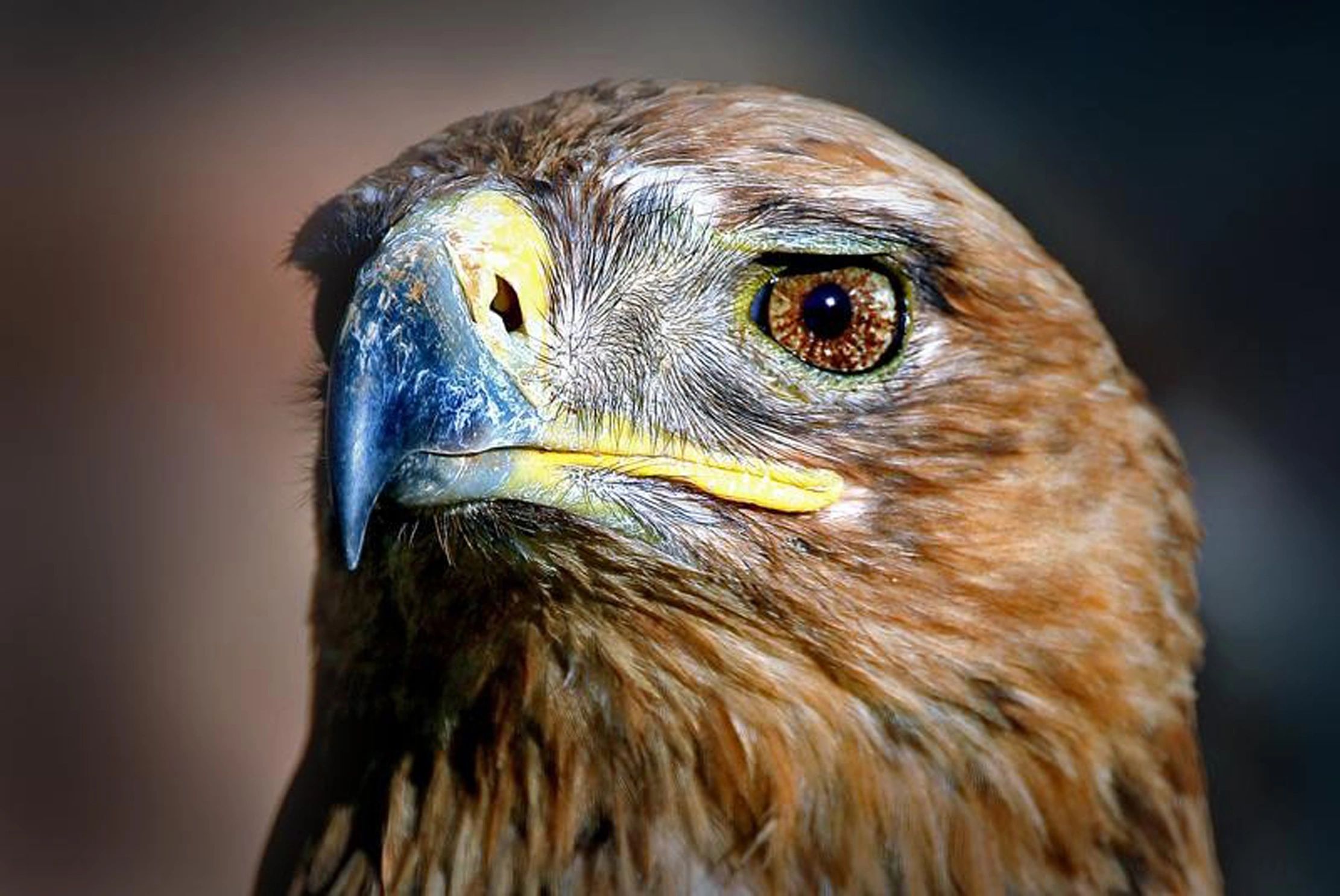
The featured photo is of 'Rosie' the Tawny Eagle at the Dullstroom Bird of Prey Centre in South Africa.
For queries please contact: