
• Home
  • Africa Wealth Report
  • UK Wealth Report
  • Articles
  • Contact
  • More
    • Home
    • Africa Wealth Report
    • UK Wealth Report
    • Articles
    • Contact

  • Home
  • Africa Wealth Report
  • UK Wealth Report
  • Articles
  • Contact

THE UK WEALTH REPORT 2026


The UK Wealth Report is the definitive guide to Britain's wealth and luxury sector, published by wealth intelligence firm New World Wealth. 


The UK is currently the 5th wealthiest country in the world when it comes to total liquid wealth held, behind USA, China, Germany and Japan. 


Crucially, Britain continues to rank ahead of key European peers like France and Italy, underscoring its enduring legacy as a premier hub for global capital and "old money" families.

KEY SECTIONS

Publication date: October 2026 (currently under embargo)
UK WEALTH STATSBRITAIN'S WEALTHIEST CITIESUK VS. USALONDON'S WEALTH EXODUSLUXURY BRAND RATINGS

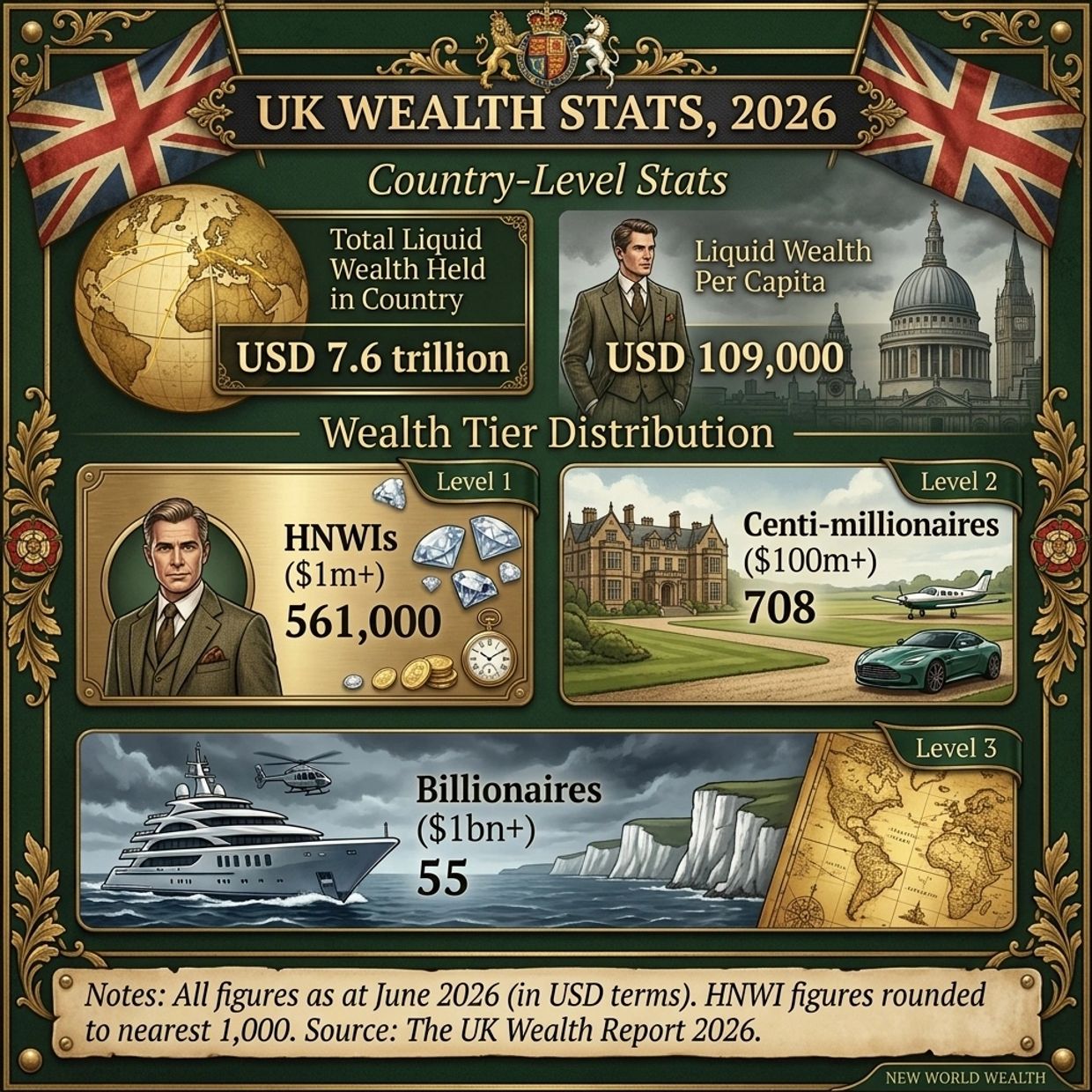
UK WEALTH STATS

Total liquid wealth held in country:

USD 7.6 trillion

Liquid wealth per capita:

USD 109,000

HNWIs ($1m+):

561,000

Centi-millionaires ($100m+):

708

Billionaires ($1bn+):

55

Notes: All figures as at June 2026 (in USD terms). HNWI figures rounded to nearest 1,000. Source: The UK Wealth Report 2026.

BRITAIN'S WEALTHIEST CITIES

London

Greater London is home to approximately 207,000 HNWIs, along with 23 billionaires as at June 2026. This makes it the 6th wealthiest city in the world. The neighborhoods of Belgravia, Knightsbridge, Mayfair, Hampstead and Regents Park are especially affluent.

Manchester & Trafford

Greater Manchester is home to 24,000 HNWIs, along with 8 billionaires as at June 2026. It is the fastest growing major city in the UK when it comes to wealth growth over the past decade.

Edinburgh

Edinburgh is the financial capital of Scotland and the 3rd wealthiest city in Britain - it is home to 9,000 HNWIs and 4 billionaires as at June 2026. The scenic suburb of 'New Town' is traditionally seen as the poshest part of the city.

Spotlight on small towns in the UK

It is interesting to note that wealth growth in the small towns has generally outperformed wealth growth in the big UK cities over the past 10 years. Top performers include the likes of Taplow, Marlow, Henley-on-Thames, Alderley Edge, Hale, Virginia Water, Leatherhead and Weybridge, as well as several towns in the Cotswolds.


Larger towns such as Poole and Harrogate have also attracted significant wealth over this period.

UK vs. USA - differing paths since the 2008 financial crisis


If one reviews recent wealth trends, it is noticeable that Britain’s economy has struggled to create new wealth ever since the 2008 global financial crisis, with per capita wealth levels in the country up by only +30% since year-end 2007 (when measured in USD terms) according to our in-house wealth tracker.  Over this same period (2007 to 2026), global wealth per capita levels have risen by +149%, with USA seeing a dramatic rise of +206%. 


The contrast with USA is even more alarming at a stock market level. The UK’s main equity index (the FTSE 100) has risen by a modest +9% since year-end 2007 (when measured in USD terms), whilst the DJIA is up +301% and the S&P 500 is up +418% over the same period (2007 to 2026).

LONDON'S WEALTH EXODUS

The UK, and London especially, has traditionally been seen as one of the world’s top destinations for migrating millionaires and for many years (from the 1950s to early 2000s) it consistently attracted large numbers of wealthy families from Mainland Europe, Africa, Asia, and the Middle East. However, this trend began to reverse after the 2008 financial crisis as more millionaires began to leave the country and fewer came in, with Brexit having an exacerbating effect.


We provisionally expect Britain to lose approximately 11,000 HNWIs to migration in 2026. If this figure materializes, this will mean that over 45,000 HNWIs would have left the UK post-covid (2020 to 2026) on a net basis – this equates to around 8% of the country's total high-net-worth population, which currently stands at just over 560,000 HNWIs as at June 2026.  


The loss has been especially dramatic at the top-end of the wealth pyramid with the number of billionaires living in the UK dropping from 102 in 2020 to 55 in 2026. 


The top destinations for these billionaires have been Monaco, Italy, the UAE, Switzerland and the Channel Islands.

WHY IS BRITAIN LOSING HNWIS?

  • The UK has become less welcoming to foreign wealth, introducing sanctions on Russian millionaires and closing its investor visa program in 2022. The UK's much maligned non-dom scheme was also recently abolished in 2025. 


  • Brexit, which damaged London's dominance as Europe's top financial centre. It has also made the city less appealing as a base location for global bankers, venture capitalists and financiers.


  • The growing dominance of USA and Asia in the global hi-tech space has eroded the UK's wealth creation potential.


  • The dwindling importance of the London Stock Exchange. This exchange was once the largest stock market in the world by market cap, but it now ranks 12th globally. The past two decades have been particularly poor, with a large number of delistings and relatively few new IPOs.  


  • Rising religious tensions. In particular, rising anti-Semitism may be pushing Jewish business leaders & entrepreneurs to leave the UK. If one reviews the public rich lists, it is noticeable that very few Jewish billionaires still remain in the UK today. Almost all of them have left over the past decade.


  • Capital gains tax and estate duty (IHT) rates in the UK are amongst the highest in the world (40%), which deters wealthy business owners and retirees from living there. It is worth noting that Australia, New Zealand, Canada, Malta, Montenegro, the UAE, Singapore and Israel do not levy estate duty, whilst in Italy its only 4%. This makes the UK an outlier.


  • The healthcare system in the UK is deteriorating, which may be deterring affluent people from living in the country. In a high-tax country such as the UK it is essential to have a functional healthcare system in order to prove to taxpayers that their money is being well spent.


  • Rising safety concerns, especially in big cities such as London – this deters entrepreneurs from living in country and also impacts on business formation.


  • The UK wealth management and family office sector is showing signs of decline, with billionaires and centi-millionaires now preferring to park their money in emerging financial hubs such as Dubai. This sector was once the "Jewel in London's Crown" and is a major loss.


  • Leaving the UK is significantly easier than leaving other European countries as there is no language barrier. This is perhaps why HNWI departures from other high-tax countries in Europe (Germany, Spain and France) are traditionally much lower than those from the UK.


UK vs. USA - Tax Spotlight:

There is an argument developing that in the modern world an economy is not sustainable if its tax rates are higher than America's, unless it has fantastic public services of course but even then it's a long-term risk in our view. 


USA has competitive advantages in most key sectors (tech, entertainment, finance) that make it impossible to compete with on an even playing field. 


The only real way to beat them when it comes to wealth creation is to either to have a more competitive workforce than them (China and Poland) or to have much lower tax rates than them (Malta, UAE and Montenegro) - see world's fastest growing wealth markets.  

Why Millionaire Migration Matters


Millionaire migration is a crucial measure for the economic and social health of a country for a number of reasons, including:


LEADING INDICATOR

A “leading indicator” is a measurable metric that changes before broader economic & social trends. High-net-worth individuals are highly mobile and often the first to relocate when conditions in their home country deteriorate or when better opportunities arise elsewhere.


FOREX REVENUE

Migrating millionaires are a vital source of forex revenue as they tend to bring their money with them when they move to a new country.


NEW BUSINESS

Many relocating HNWIs (around 10%) are entrepreneurs and company founders, who start businesses in their new country, thereby creating local jobs. This percentage rises to over 70% for centi-millionaires and billionaires.


STOCK MARKETS

Millionaires boost the local stock market via their equity investments. Also, some HNWIs publicly list their companies on the local stock exchange.


MULTIPLIER EFFECT

Inward wealth migration can have a multiplier effect on wealth growth due to the spillover effect on asset prices. For instance, 100 HNWIs moving to a country can result in its HNWI population increasing by well over 200 as it pushes local property and stock market prices up and therefore drives up the wealth of locals living in that country.


BOOSTS MIDDLE CLASS

The businesses started by HNWIs have a significant positive spillover effect on the middle class as they create large numbers of well-paying jobs in their base country.


TAX TAKE

Salaried HNWIs pay large amounts of income tax, whilst company founders indirectly pay large amounts of tax via their businesses – corporate tax, VAT and income tax paid via their employees. HNWIs also account for the bulk of capital gains tax collected.


SPENDING POWER

Perhaps most importantly, HNWIs indirectly create thousands of well-paying jobs via their spending power, especially in high-value sectors such as high-end fashion, prime property, luxury hotels, fine dining and wealth management.

THE UK'S TOP LUXURY BRANDS IN 2026

THE TOP WEALTH MANAGER FOR HNWIS IN THE UK

C. HOARE & CO.

THE TOP LUXURY HOTEL BRAND IN THE UK

RED CARNATION HOTEL COLLECTION

Note: These brands were selected based on their reputation for quality, appeal to HNWIs and value-for-money. 

THE WAY FORWARD


Despite its problems, there are a number of things the UK could do to improve its economic prospects.


CLOSER TIES WITH SAFE HAVEN COUNTRIES

The UK could introduce freedom of movement for passport holders from wealthy “safe haven” countries such as Australia, New Zealand, Switzerland, Malta, Luxembourg, the UAE and Singapore. This will encourage more entrepreneurs and wealthy retirees to move to the UK. Individuals from these countries are unlikely to put much strain on Britain's public services due to their relative wealth.


JOIN THE EURO

Much of the friction that exists between the UK and EU (both before and after Brexit) was due to the UK's decision not to join the Euro. The US Dollar's global dominance is now vulnerable due to recent trade wars and the Euro could finally achieve its dream of taking over as the world's standard currency but it needs the UK to join for this to work. In our view, this decision could completely reshape Europe's economy and turn London into the world's top financial centre once again.


SCRAP CAPITAL GAINS TAX AND ESTATE DUTY

These are traditionally the main taxes that wealthy entrepreneurs look at when migrating. Several countries globally have done this with strong success, including the UAE, Mauritius and Singapore. Only a tiny fraction of the UK's overall tax take comes from these two taxes, whilst they have a massively erosive impact on wealth creation.


GOLDEN TECH VISA

The UK could launch a “Golden Tech Visa” targeted at attracting wealthy tech entrepreneurs from Europe and Asia. This should ideally focus on centi-millionaires - those with over USD 100 million in liquid wealth.  The centi-millionaires are arguably the most important wealth band when it comes to wealth creation due to the large % of entrepreneurs in this segment. 

NOTES

  • The terms ‘millionaires’ or ‘high-net-worth individuals’ (HNWIs) refer to individuals with liquid wealth of USD 1 million or more. 
  • The term ‘centi-millionaires’ refers to individuals with liquid wealth of USD 100 million or more, whilst ‘billionaires’ refer to individuals with liquid wealth of USD 1 bn or more. 
  • For our purposes ‘liquid wealth’ includes equities, ETFs, cash, bonds, gold, and crypto holdings - namely, items that can be cashed in quickly. 
  • We exclude illiquid items such as property, family businesses and private equity, which is why our wealth figures tend to be lower than the other vendors.
  • All figures as at 30 June 2026 and all in USD terms.
  • HNWI figures rounded to nearest 1,000. 

Research and Methodology

COUNTRY WEALTH STATS:

The wealth and HNWI stats in this report are calculated in-house, using a Lorenz curve model to determine the wealth tiers in each country/city. Key inputs in our model include: 

  • Household income statistics in each country.
  • Market Cap of the local stock market.
  • Tax data, with a special focus on income tiers. Typically an individual with an annual income of over USD 200,000 will be a high-net-worth individual.
  • Family office numbers in each country - generally only centi-millionaires and billionaires can afford to have their own family office.
  • Prime property statistics. Specifically, we consider the number of highly priced homes in each country/city.
  • Wealth data from our in-house database of high-net-worth individuals. The database’s primary focus is on company founders and individuals from high-value companies who hold the following positions: chairperson, CEO, president, director, and managing partner. We collect city, country, work and educational details for these individuals.


New World Wealth’s model combines the above metrics in order to calculate the total wealth held in each country/city and the number of individuals in each wealth tier. For the top wealth tiers, namely, centi-millionaires and billionaires, the firm predominantly relies on its in-house database of high-net-worth individuals.


Note: It should be noted that New World Wealth never discloses the names of the individuals in its database, which it uses purely for in-house statistical studies.


MIGRATION STATS:

The following sources are consulted when mapping the migration of high-net-worth individuals:

  • Annual & monthly golden visa stats, which are a useful barometer for HNWI inflows as they are generally only affordable for individuals with liquid wealth exceeding USD 5 million. They are especially useful for business hubs such as USA (EB5) and offshore hubs such as the UAE, Monaco, Cayman Islands and Singapore due to the high likelihood of movement. They are less useful for second homes hotspots such as Greece and Portugal although they still provide a useful sanity check for these markets.
  • Company registers — with a focus on filings by directors that indicate a change in country of residence.
  • Updates to city locations for major company founders on LinkedIn.
  • Monitoring where new family offices are being established — typically, only centi-millionaires and billionaires (with liquid wealth exceeding USD 100 million) have the resources to set up a dedicated family office.
  • Statistics from high-end international removal firms — offering insight into where affluent clients are moving.


Notes & assumptions:

  • If a HNWI changes their location on a company register, we assume they have moved.
  • If a HNWI changes their location on LinkedIn, we assume they have moved.
  • If a major news outlet reports about a HNWI moving, we assume they have moved. This is normally only relevant for public figures and billionaires.
  • If a HNWI sets up a family office abroad, we assume they have moved.

About New World Wealth


New World Wealth was established in 2013 and has been tracking the movements and spending habits of the world’s wealthiest people for over a decade.


Our reports and findings have been referenced by the Australian and UK governments, as well as by global news outlets such as Bloomberg, CNN, Forbes, CNBC and Robb Report.


This report features art by Vladimir Tretchikoff, who was featured in our recent Africa Wealth Report as one of Africa's most bankable artists.


For queries please contact:

andrew@newworldwealth.com

Copyright © 2026 New World Wealth - All Rights Reserved.

Powered by
